Orthopedic Saw Blades: Sagittal, Oscillating and Reciprocating Blades Explained
ZHONGJIAN TECH guide to orthopedic saw blades: sagittal, oscillating and reciprocating types for large bone, small bone, sternum, couplings and cut thickness.
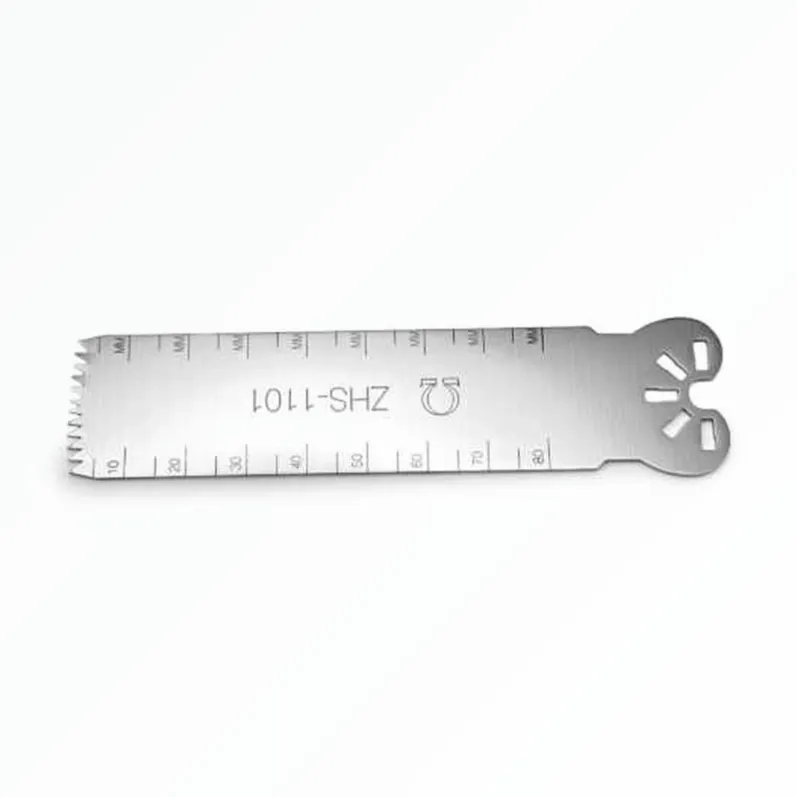
An orthopedic saw blade is not a single product. It is a family of blades that differ in three ways at once: how the blade moves, which bone it is sized for, and which handpiece it couples to. A blade that is right for a large bone may be the wrong size for a small bone. A blade that fits one handpiece will not fit another. And a blade whose cut is too thick for the procedure wastes bone, while one whose cut is too thin may not do the work required. This guide explains the ZHONGJIAN TECH saw-blade range using the catalog figures, so a buyer can match motion type, bone size and coupling before ordering.
ZHONGJIAN TECH supplies six saw-blade products: Large Bone Sagittal Saw Blades, Large Bone Oscillating Saw Blades, Large Bone Reciprocating Saw Blades, Small Bone Oscillating and Sagittal Blades, Small Bone Sagittal and Reciprocating Blades, and Sternum Saw Blades. Together they cover large bone, small bone and sternum work, in sagittal, oscillating and reciprocating motion. The sections below take each group in turn, and then explain couplings, tooth types and cut thickness, which are the details that apply across the whole range.
Sagittal, Oscillating and Reciprocating: Three Motions
The first distinction between saw blades is the motion of the blade. A sagittal blade moves in an arc, sweeping from side to side around the axis of the handpiece. An oscillating blade moves back and forth in a short arc, reversing direction rapidly. A reciprocating blade moves straight back and forth, in and out along its length. Each motion suits a different kind of cut, and each blade in the ZHONGJIAN TECH range is listed under one of these three motions.
The product names make the motion visible. Large Bone Sagittal Saw Blades are sagittal blades for large bone. Large Bone Oscillating Saw Blades are oscillating blades for large bone. Large Bone Reciprocating Saw Blades are reciprocating blades for large bone. The small-bone products combine two motions in one product: Small Bone Oscillating and Sagittal Blades, and Small Bone Sagittal and Reciprocating Blades. Sternum Saw Blades include both fan blades, which are oscillating blades, and straight reciprocating blades. A buyer should therefore start by confirming which motion the procedure and the handpiece require, and then look within the product for that motion.
Motion alone does not settle the choice. Two blades with the same motion can differ in length, width, material thickness and cut thickness, and those four figures decide whether the blade reaches the site and cuts as required. The catalog gives all four figures for every blade family, and they are quoted in the sections below.
Large Bone Sagittal Saw Blades
Large Bone Sagittal Saw Blades are the largest sagittal blades in the range. Their prefixes are AL, BJ, AJ, EJ and FJ. Length runs from 20.0 to 100.0 mm, width from 9.0 to 29.0 mm, material thickness from 0.64 to 1.50 mm, and cut thickness from 0.80 to 1.82 mm. Some blades in this family carry a printed depth scale, marked at 10 mm intervals, which is part of the blade itself.
The part-number examples show the size range in practice. AL10020110 is a 20.0 by 9.6 mm blade with a cut thickness of 1.10 mm. AL30060100 is a 59.5 by 29.5 mm blade with a cut thickness of 1.00 mm. BJ17034182 is a 34.0 by 16.5 mm blade with a material thickness of 1.24 mm and a cut thickness of 1.82 mm. FJ25100127 is a 100.0 by 25.0 mm blade with a material thickness of 1.27 mm and a cut thickness of 1.27 mm. These four examples span the family from its smallest to its largest, and they show how length, width and cut thickness vary independently: a long blade is not necessarily a wide blade, and a thick blade is not necessarily a wide-cutting blade.
Coupling for this family is given for the BJ, AJ, EJ and FJ prefixes, which use coupling J, Stryker Large Bone Sagittal. For the AL prefix, the catalog does not state a coupling, and the coupling codes listed in the catalog contain no code L. A buyer ordering an AL blade should therefore confirm the coupling before ordering, rather than assuming it matches the rest of the family. The product page for Large Bone Sagittal Saw Blades states this openly.
Large Bone Oscillating Saw Blades
Large Bone Oscillating Saw Blades carry the prefixes BE, DE, EE and AE. Length runs from 63.0 to 95.0 mm, width from 10.0 to 49.0 mm, material thickness from 0.60 to 1.50 mm, and cut thickness from 0.90 to 1.50 mm. The examples are BE20063090, a 63.0 by 13.5 mm blade with a cut thickness of 0.90 mm; DE33063090, a 63.0 by 33.0 mm blade with a cut thickness of 0.90 mm; and EE25090150, a 90.0 by 25.4 mm blade with a material thickness of 1.50 mm and a cut thickness of 1.50 mm. The first two examples share the same length and cut thickness but differ in width, which is a useful reminder that width is chosen separately from length.
All four prefixes in this family end in E, and the coupling is E, ConMed Linvatec Large Bone Oscillating. That makes this family straightforward to order on coupling: if the handpiece uses the ConMed Linvatec large bone oscillating coupling, these blades match it. The buyer still needs to choose length, width and cut thickness from the ranges above, but the coupling question has a single answer for the whole family.
Large Bone Reciprocating Saw Blades
Large Bone Reciprocating Saw Blades carry the prefixes BC, AC and BA. Length runs from 38.0 to 88.0 mm, width from 6.3 to 12.8 mm, material thickness from 0.38 to 1.27 mm, and cut thickness from 0.53 to 1.78 mm. The examples are BC09038064, a 38.0 by 9.4 mm blade with a cut thickness of 0.64 mm; AC13069097, a 69.0 by 12.7 mm blade with a cut thickness of 0.97 mm; and BC12088178, an 88.0 by 12.2 mm blade with a material thickness of 1.27 mm and a cut thickness of 1.78 mm.
Coupling in this family depends on the prefix. BC and AC use coupling C, ConMed Linvatec Large Bone Reciprocating. BA uses coupling A, Stryker Large Bone Reciprocating. A buyer should therefore check the prefix of the blade they need, not only the family name, because the two couplings in this family are different. The width range in this family is also narrower than in the sagittal and oscillating families — 6.3 to 12.8 mm — which reflects the straight, narrow shape of a reciprocating blade.
Small Bone Blades
Small bone work uses smaller blades, and the ZHONGJIAN TECH range has two small-bone products. The first, Small Bone Oscillating and Sagittal Blades, carries the prefixes AH and BH. Length runs from 10.0 to 39.0 mm, width from 5.5 to 16.5 mm. Material thickness is 0.40 or 0.51 mm, and for BH blades it is 0.40 mm. Cut thickness is 0.40 or 0.51 mm, and for BH blades it is 0.60 mm. The examples are AH09010040, a 10.0 by 9.0 mm blade at 0.40 mm material and 0.40 mm cut; AH06012051, an 11.5 by 5.5 mm blade at 0.51 mm material and 0.51 mm cut; BH09025060, a 25.0 by 9.0 mm blade with a cut thickness of 0.60 mm; and AH13039051, a 39.0 by 13.0 mm blade at 0.51 mm material and 0.51 mm cut. The coupling for this family is H, Stryker Oscillating and Sagittal.
The second small-bone product, Small Bone Sagittal and Reciprocating Blades, covers three groups. The BW group is straight sagittal blades with a U-coupling: length 12.0 to 32.0 mm, width 5.0 to 17.5 mm, material 0.38 to 0.40 mm, cut 0.64 to 0.70 mm, with examples BW06012070 at 12.0 by 5.5 mm and BW10032068 at 31.5 by 9.5 mm with a cut of 0.68 mm. The BZ and AZ groups are long narrow and fan blades: length 6.6 to 41.3 mm, width 9.5 to 96.5 mm, material 0.64 mm, cut 0.80 to 1.10 mm, with fan blades at 0.90 mm, and examples BZ12007110 at 7.3 by 12.0 mm and AZ41013090 at 12.7 by 41.1 mm. The AD group is reciprocating blades: length 14.5 to 40.5 mm, width 2.7 to 7.5 mm, cut 0.60 to 1.00 mm, with examples AD04015090 at 14.5 by 3.8 mm with a cut of 0.90 mm and AD06027060 at 27.0 by 6.1 mm with a cut of 1.00 mm. No material thickness column is given for the AD group in the catalog. Coupling W, Stryker Small Sagittal, applies to the BW group, and coupling D, Stryker Small Bone Reciprocating, applies to the AD group. For the BZ and AZ groups, the catalog does not state a coupling, and the coupling codes contain no code Z, so a buyer should confirm the coupling before ordering.
The two small-bone products overlap in the catalog's grouping: small-bone sagittal blades appear in both. Each part number is listed once on the ZHONGJIAN TECH site, and the two product pages cross-link to each other, so a buyer should not order the same part number twice under two products.
Sternum Saw Blades
Sternum Saw Blades carry the prefixes AE, AY, AG, AZ, AA and AC, and they come in two shapes. Fan blades, which are oscillating blades, run from 19.0 to 45.0 mm in length and 41.9 to 83.0 mm in width, with a cut thickness of 0.60 to 1.10 mm. Some carry a printed depth scale at 10, 20 and 30 mm. Examples are AE51019070, a 19.0 by 51.0 mm blade with a cut of 0.70 mm, and AG8304500, a 45.0 by 83.0 mm blade with a cut of 1.10 mm. Straight reciprocating blades run from 31.0 to 53.6 mm in length and 6.1 to 6.6 mm in width, with a cut thickness of 1.00 mm. Examples are AZ06031100, a 31.0 by 6.1 mm blade, and AC07054100, a 53.6 by 6.6 mm blade.
Couplings in this family are E for AE, G for AG, A for AA and C for AC. For the AY and AZ prefixes, the catalog does not state a coupling, and the coupling codes contain no code Y or Z, so a buyer should confirm the coupling before ordering. The fan blades are wide — up to 83.0 mm — and the straight blades are narrow — 6.1 to 6.6 mm — so the two shapes should not be confused when ordering. Length, width and cut thickness should be checked for the shape required, not for the family as a whole.
Couplings and Tooth Types
Every saw blade in the range is identified by a prefix, and the prefix carries the coupling. The catalog lists sixteen coupling codes, from A to W, each naming a handpiece system: A is Stryker Large Bone Reciprocating, B is ConMed Linvatec, Brasseler MicroAire and Smith and Nephew Small Bone and Micro Reciprocating, C is ConMed Linvatec Large Bone Reciprocating, D is Stryker Small Bone Reciprocating, E is ConMed Linvatec Large Bone Oscillating, G is DePuy Synthes and Zimmer Biomet Large Bone Oscillating, H is Stryker Oscillating and Sagittal, I is Aesculap Large Bone Saw, J is Stryker Large Bone Sagittal, K is ConMed Linvatec Large Bone Oscillating, M is ConMed Linvatec Small Bone and Micro Mini-Driver Sagittal, N is ConMed Linvatec, Brasseler MicroAire and Smith and Nephew Small Bone and Micro Sagittal, Q is ConMed Linvatec, Brasseler MicroAire and Smith and Nephew Small Bone and Micro Oscillating, T is ConMed Linvatec Large Bone Oscillating, V is ConMed Linvatec Small Bone and Micro Mini-Driver Sagittal, and W is Stryker Small Sagittal.
A buyer who knows the handpiece can work backwards from the coupling code to the blades that fit it. A buyer who knows the blade can work forwards from its prefix to the coupling it needs. Either way, the coupling should be confirmed before ordering, because a blade with the wrong coupling does not fit, however well its size matches. Where the catalog does not state a coupling — for the AL prefix in the large bone sagittal family, the BZ and AZ prefixes in the small bone sagittal family, and the AY and AZ prefixes in the sternum family — ZHONGJIAN TECH states this openly and asks the buyer to confirm before ordering, rather than guessing.
Tooth types are listed as A, B, C, D, E and F, and the width of the tooth varies by blade. The catalog gives no tooth-pitch table, so no pitch values are published on the ZHONGJIAN TECH site. A buyer who needs a particular tooth pitch should ask, and should not assume a value from the tooth type letter alone.
Cut Thickness and Material Thickness
Two thickness figures appear for every blade, and they are different. Material thickness is the thickness of the blade itself. Cut thickness is the width of the cut the blade makes, which is wider than the blade because of the set of the teeth. Both figures matter. Material thickness affects how the blade behaves in the cut, and cut thickness decides how much bone is removed. The catalog gives both figures for every family except the AD reciprocating group, where no material thickness column is given.
A buyer should compare cut thickness across blades, not material thickness alone. In the large bone sagittal family, cut thickness runs from 0.80 to 1.82 mm while material thickness runs from 0.64 to 1.50 mm. In the large bone oscillating family, cut thickness runs from 0.90 to 1.50 mm. In the large bone reciprocating family, cut thickness runs from 0.53 to 1.78 mm. In the small bone families, cut thickness is as fine as 0.40 mm. The finest cut in the range is not necessarily the best choice for every procedure; it is the choice for the procedure that needs the finest cut. The product pages give both figures for each family, and the examples quoted above show how the two figures relate for individual part numbers.
How to Order
Ordering a saw blade from ZHONGJIAN TECH comes down to five answers. First, motion: sagittal, oscillating or reciprocating? Second, bone size: large bone, small bone or sternum? Third, size: length, width, material thickness and cut thickness from the ranges for that family, checked against the part-number examples. Fourth, coupling: which of the sixteen coupling codes, checked prefix by prefix, with the AL, BZ, AZ and AY prefixes confirmed before ordering because the catalog does not state their couplings. Fifth, tooth type: A to F, with no pitch value assumed, because the catalog publishes no tooth-pitch table.
Working through those five questions produces a part number that can be checked against the catalog. The ZHONGJIAN TECH saw-blade pages also link to related products: the drill range, including Twist Drills - AO Quick Connect, is used alongside saw blades in many procedures, and Pulse Lavage Kits and Tips are used for irrigation in orthopedic surgery. If any of the five answers is uncertain, confirm it before ordering rather than ordering a blade that does not fit the handpiece or does not cut as required.